MCP in Procurement
Learn how Model Context Protocol (MCP) enables AI systems to seamlessly connect with your procurement tools, ERPs, and data sources.
Course Overview
Duration
45-60 minutes
Level
Intermediate
Lessons
6 lessons
What you'll learn:
- What MCP is and why it matters for procurement AI
- How MCP architecture enables AI-to-system communication
- Real-world MCP use cases in procurement workflows
- How to integrate MCP with ERPs, CLMs, and sourcing platforms
- Security, governance, and best practices for MCP deployment
Introduction to Model Context Protocol (MCP)
Model Context Protocol (MCP) is an open standard that enables AI applications to securely connect with external data sources, tools, and systems. For procurement, MCP represents a breakthrough in how AI can interact with your existing technology stack.
What is MCP?
Think of MCP as a universal translator between AI systems and your enterprise applications. Instead of building custom integrations for every AI-to-system connection, MCP provides a standardized protocol that any AI can use to communicate with any compatible system.
MCP defines a common language for AI systems to request data, execute actions, and receive responses from external systems—regardless of the underlying technology.
MCP enables AI to understand the context of your procurement data—supplier relationships, contract terms, spend patterns—and use this context to provide more relevant insights and recommendations.
MCP includes built-in security features like authentication, authorization, and audit logging to ensure safe AI-to-system communication.
Why MCP Matters for Procurement
Procurement organizations typically operate with a complex technology ecosystem: ERPs, CLMs, sourcing platforms, supplier portals, spend analytics tools, and more. Traditionally, integrating AI with these systems required custom development for each connection.
MCP changes this by providing:
- Reduced integration complexity: Build once, connect to many systems
- Faster AI deployment: Get AI working with your existing tools in days, not months
- Better AI performance: AI with access to real-time procurement data makes better decisions
- Future-proofing: As new AI capabilities emerge, MCP connections remain compatible
MCP is to AI integration what USB was to hardware connectivity—a universal standard that simplifies connections and enables interoperability across different systems and vendors.
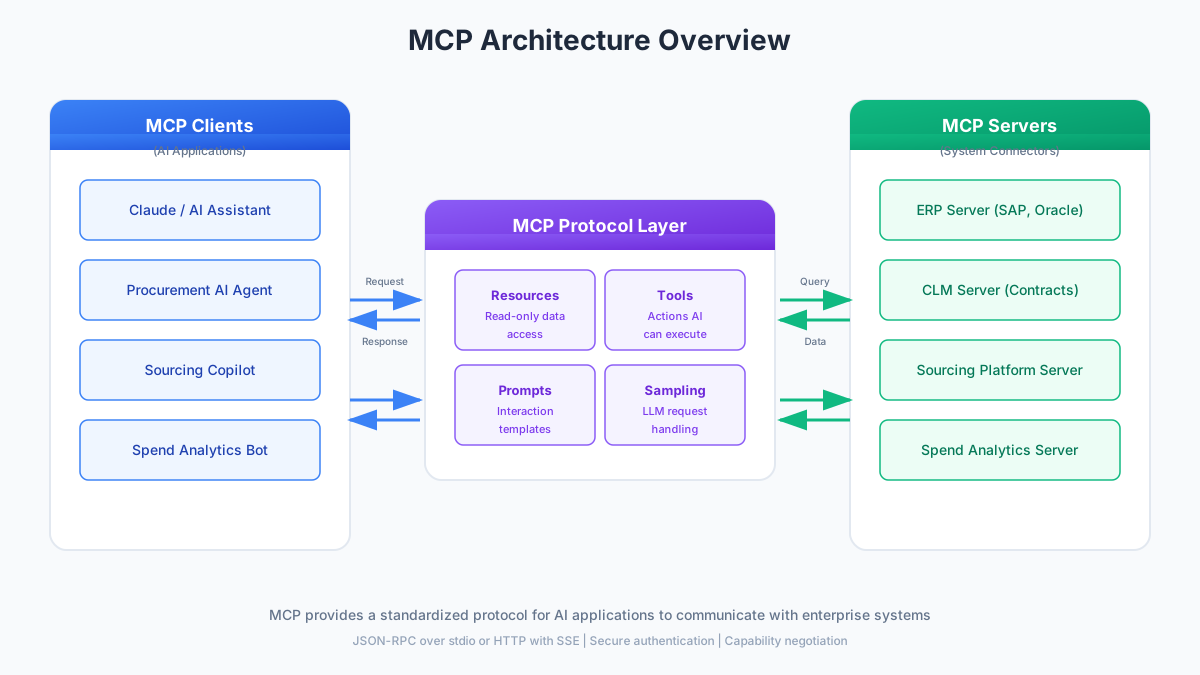
Figure 1: MCP Architecture Overview - Clients, Protocol Layer, and Servers
MCP Architecture and Components
Understanding MCP architecture helps you design effective AI integrations for your procurement systems. MCP follows a client-server model with well-defined components.
Core Components
MCP servers expose your procurement systems (ERP, CLM, sourcing platforms) to AI applications. Each server provides a standardized interface to its underlying data and capabilities. For example, an SAP MCP server might expose purchase order data, supplier master records, and contract information.
MCP clients are AI applications that connect to MCP servers to access procurement data and execute actions. The AI uses the MCP protocol to discover available capabilities, request information, and trigger workflows.
The MCP protocol defines how clients and servers communicate, including message formats, capability negotiation, error handling, and security mechanisms.
MCP Capabilities in Procurement
MCP servers can expose different types of capabilities to AI systems:
Read-only access to procurement data like supplier information, contract terms, spend data, and historical RFPs. AI can query these resources to inform its analysis and recommendations.
Actions that AI can execute in procurement systems—creating purchase requisitions, updating supplier records, generating reports, or triggering approval workflows.
Pre-defined templates that help AI understand how to interact with specific procurement scenarios, ensuring consistent and appropriate behavior.
How MCP Communication Works
A typical MCP interaction in procurement follows this pattern:
- Discovery: AI client connects to MCP server and discovers available resources and tools
- Request: AI requests specific data (e.g., "Get all contracts expiring in 30 days")
- Processing: MCP server validates the request, queries the underlying system, and formats the response
- Response: Server returns data to AI in a standardized format
- Action: Based on analysis, AI may request to execute a tool (e.g., "Create renewal reminder")
- Confirmation: Server confirms action completion with results
MCP uses JSON-RPC over various transport mechanisms (stdio, HTTP with SSE). This flexibility allows MCP servers to run locally alongside desktop applications or remotely in cloud environments.
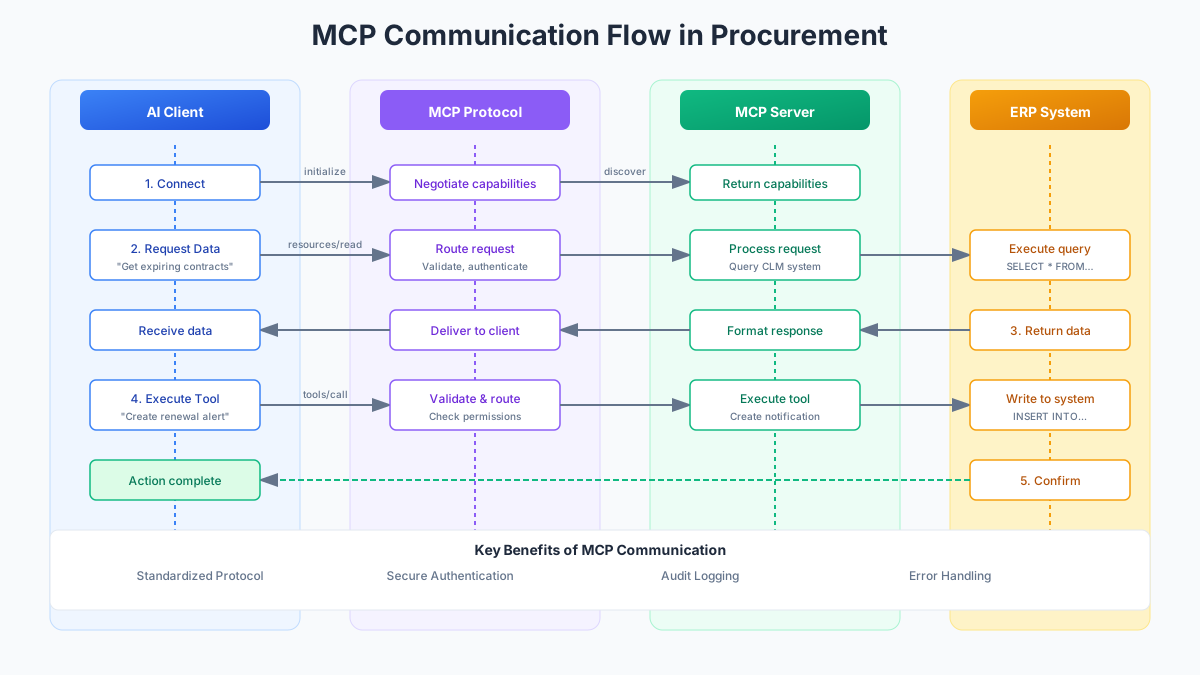
Figure 2: MCP Communication Flow - From Request to Response
MCP Use Cases in Procurement
MCP enables powerful AI-driven procurement workflows by connecting AI systems directly to your operational data and tools. Here are key use cases:
1. Intelligent Contract Analysis
Scenario: An AI assistant connected via MCP to your contract management system can:
- Automatically identify contracts approaching renewal
- Analyze contract terms against current market benchmarks
- Flag unfavorable clauses or compliance risks
- Suggest negotiation points based on historical data
- Generate renewal recommendation reports
2. Real-Time Spend Insights
Scenario: With MCP connections to your ERP and spend analytics tools, AI can:
- Provide instant answers to spend-related questions ("What did we spend on IT services last quarter?")
- Identify spending anomalies or policy violations in real-time
- Track savings against category targets
- Recommend consolidation opportunities across business units
- Generate executive spend reports on demand
3. Supplier Intelligence and Risk Monitoring
Scenario: MCP enables AI to combine internal supplier data with external intelligence:
- Monitor supplier financial health indicators
- Track news and regulatory changes affecting key suppliers
- Correlate performance data across multiple contracts
- Alert procurement teams to emerging supplier risks
- Recommend alternative suppliers based on risk profiles
4. Automated RFX Workflows
Scenario: AI connected to your sourcing platform via MCP can orchestrate entire RFX processes:
- Generate RFP documents from requirements stored in your systems
- Identify and invite qualified suppliers from your database
- Manage supplier Q&A by searching knowledge bases for answers
- Normalize and compare supplier responses automatically
- Prepare evaluation summaries with data from multiple sources
5. Purchase Requisition Assistance
Scenario: MCP enables AI to guide users through procurement processes:
- Help users find preferred suppliers and existing contracts
- Validate requisitions against policies before submission
- Suggest appropriate approval workflows based on value and category
- Track requisition status across systems
- Answer questions about procurement policies and procedures
The power of MCP compounds when AI can access multiple systems simultaneously. For example, AI analyzing a supplier proposal can pull contract history from CLM, spend data from ERP, performance metrics from supplier management, and market benchmarks from external sources—all in a single interaction.
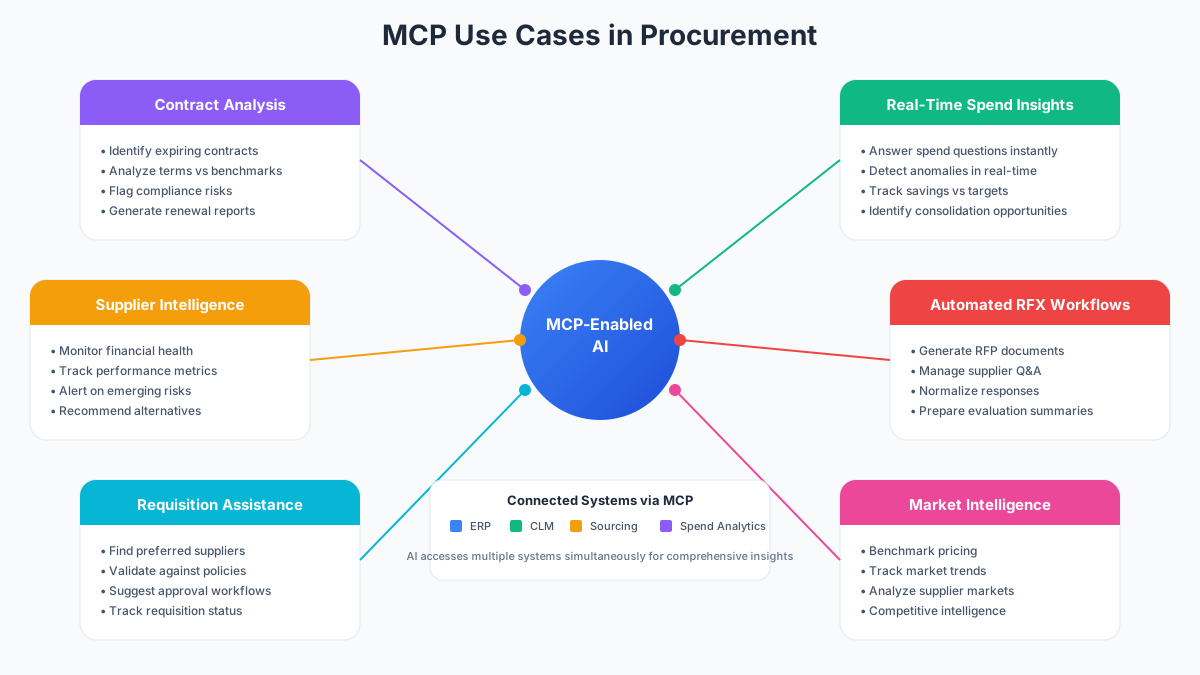
Figure 3: MCP Use Cases in Procurement - Connected AI Applications
Implementing MCP in Your Procurement Stack
Implementing MCP in your procurement environment requires planning, but the modular nature of MCP allows for incremental deployment. Here's how to approach it:
Step 1: Inventory Your Systems
Start by mapping your procurement technology landscape:
- Core systems: ERP (SAP, Oracle, Microsoft), sourcing platforms, CLM systems
- Data sources: Spend databases, supplier master data, contract repositories
- External services: Market intelligence, credit ratings, compliance databases
- Workflow tools: Approval systems, notification platforms, collaboration tools
Step 2: Prioritize MCP Connections
Not all systems need MCP connections immediately. Prioritize based on:
Systems with data that AI needs frequently—contract databases, spend analytics, supplier master data.
Systems involved in daily workflows—ERP for purchase orders, sourcing platforms for RFX management.
Systems with existing APIs or connectors that can be wrapped with MCP interfaces more easily.
Step 3: Build or Deploy MCP Servers
You have several options for creating MCP servers:
- Pre-built servers: Many vendors offer MCP servers for common enterprise systems
- Custom development: Build MCP servers for proprietary or legacy systems
- Hybrid approach: Use pre-built servers where available, custom for gaps
Step 4: Configure AI Clients
Connect your AI applications to MCP servers:
Configure secure authentication between AI clients and MCP servers. Use your organization's identity provider where possible.
Define what resources and tools each AI application can access. Apply least-privilege principles.
Configure how AI should use procurement context—which data sources to prioritize, how to handle conflicting information.
Step 5: Test and Validate
Before production deployment:
- Test MCP connections with representative procurement scenarios
- Validate data accuracy between source systems and MCP responses
- Verify security controls and access restrictions
- Measure performance and optimize for acceptable response times
- Document any limitations or edge cases for users
Start with read-only MCP connections (resources) before enabling write capabilities (tools). This allows you to validate AI behavior and build confidence before allowing AI to make changes in your systems.
Security and Governance for MCP
Connecting AI to your procurement systems via MCP requires careful attention to security and governance. Here's how to ensure safe, compliant MCP deployments.
Security Considerations
Implement strong authentication for MCP connections. Use your existing identity provider (Okta, Azure AD, etc.) to manage AI service accounts with the same rigor as human users.
Define granular permissions for what data AI can access and what actions it can perform. Implement role-based access control (RBAC) for MCP capabilities.
Ensure all MCP communication is encrypted in transit (TLS) and sensitive data is encrypted at rest. Protect API keys and credentials.
Deploy MCP servers within your security perimeter. Use network segmentation to limit exposure. Consider private endpoints for cloud deployments.
Governance Framework
Establish governance policies for MCP-enabled AI in procurement:
- Data classification: Define which procurement data categories AI can access (public, internal, confidential, restricted)
- Action boundaries: Specify which procurement actions AI can perform autonomously vs. requiring human approval
- Audit requirements: Log all MCP interactions for compliance and troubleshooting
- Review cadence: Regularly review AI access and activity patterns
Audit and Compliance
MCP deployments should support your compliance requirements:
Log all MCP requests and responses including: who (AI client), what (resource/tool accessed), when (timestamp), and outcome (success/failure).
Maintain tamper-proof audit trails for all AI actions in procurement systems. Link AI actions to originating user requests.
Generate reports showing AI activity by system, data type, and action category to support SOX, GDPR, or other compliance requirements.
Human Oversight Controls
Maintain appropriate human oversight:
- Approval workflows: Require human approval for high-value or high-risk AI actions
- Kill switches: Ability to immediately disable MCP connections if issues arise
- Rate limiting: Prevent AI from overwhelming systems or making excessive changes
- Anomaly detection: Alert humans when AI behavior deviates from expected patterns
Treat MCP-enabled AI as a privileged system user. Apply the same security standards you would for a system administrator or integration service account—regular access reviews, activity monitoring, and principle of least privilege.
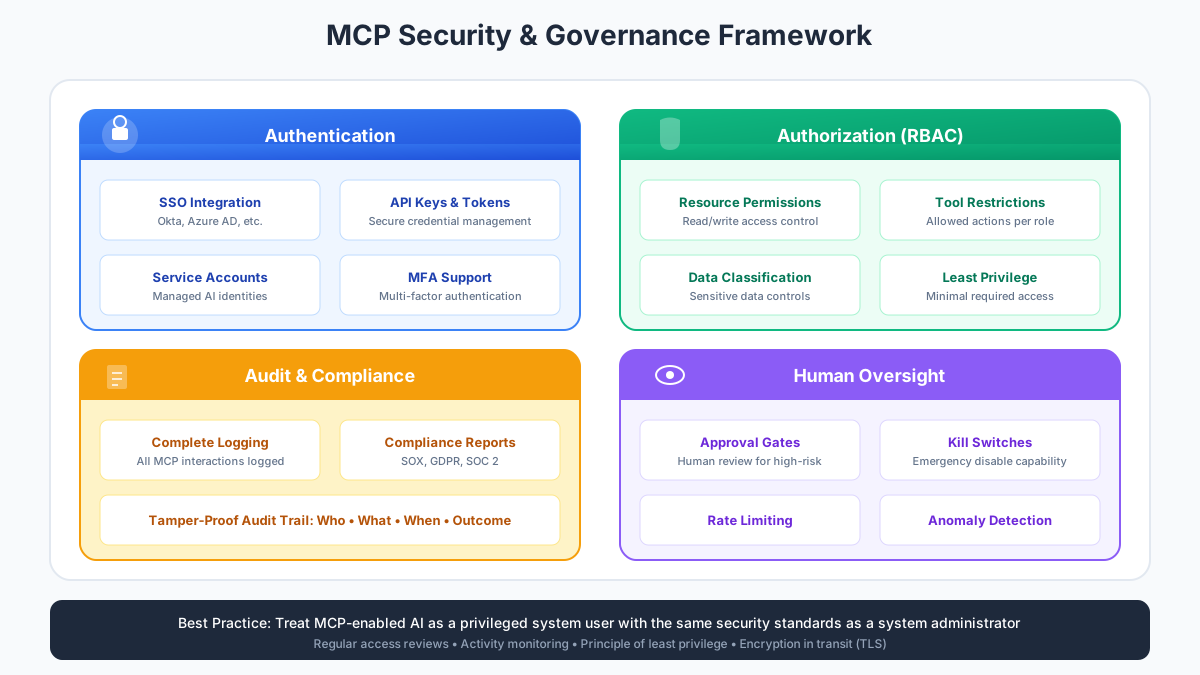
Figure 4: MCP Security & Governance Framework
Best Practices and Future of MCP in Procurement
As you implement and scale MCP in your procurement organization, following best practices will help ensure success. Here's what we've learned from leading implementations.
Implementation Best Practices
Begin with one or two high-value MCP connections (e.g., contract database and spend analytics). Prove value quickly, then expand systematically.
Build MCP servers with proper error handling, retry logic, and graceful degradation. AI should handle unavailable systems gracefully.
Cache frequently accessed data where appropriate. Use pagination for large datasets. Monitor response times and optimize bottlenecks.
Maintain clear documentation of MCP capabilities, data mappings, and limitations. This helps AI use context appropriately and supports troubleshooting.
Design MCP implementations to evolve with your systems and AI capabilities. Use versioning and maintain backward compatibility.
Common Pitfalls to Avoid
Over-exposing data: Don't make all data available to AI. Apply data minimization principles.
Ignoring rate limits: AI can generate many requests quickly. Implement rate limiting to protect source systems.
Skipping testing: Thoroughly test MCP connections before production. Verify data accuracy and action outcomes.
Neglecting monitoring: Implement comprehensive monitoring from day one. You need visibility into MCP health and usage.
The Future of MCP in Procurement
MCP is evolving rapidly, and its role in procurement will expand:
- Broader ecosystem: More vendors will offer pre-built MCP servers for procurement systems
- Deeper integration: MCP will enable more sophisticated AI workflows across the procurement lifecycle
- Standard adoption: MCP will become a standard requirement for enterprise procurement technology
- Enhanced capabilities: New MCP features will support more complex AI interactions and multi-agent scenarios
- Industry templates: Pre-built MCP configurations for common procurement scenarios will emerge
Getting Started
Ready to implement MCP in your procurement organization? Here are your next steps:
- Assess your current procurement technology stack and identify MCP opportunities
- Define your AI use cases and required system connections
- Evaluate available MCP servers for your systems or plan custom development
- Establish security and governance requirements
- Start with a pilot project to prove value
- Scale based on learnings and business priorities
MCP is the foundation for AI-powered procurement transformation. By providing standardized, secure connections between AI and your procurement systems, MCP enables the intelligent automation and decision support that drives competitive advantage. Start building your MCP infrastructure today to be ready for the AI-native procurement future.
Test Your Knowledge
Complete this quiz to test your understanding of MCP in procurement concepts and applications.
MCP in Procurement
Question 1 of 8Test your understanding of Model Context Protocol (MCP) and how it enables AI systems to connect with procurement tools and data sources.
What is Model Context Protocol (MCP)?
Congratulations!
You've completed the MCP in Procurement course. You now understand how Model Context Protocol enables AI to connect with your procurement systems for intelligent automation and insights.