
Automate your sourcing cycle.Cut time by 40–60%.
How to automate RFP, RFQ, and RFI processes with AI - from document generation through vendor scoring and audit-ready compliance.
Course Overview
What you will learn.
RFX automation uses AI and workflow technology to streamline the entire procurement document lifecycle - from creating RFPs and RFQs to collecting vendor responses, scoring proposals, and generating audit-ready reports. It replaces manual, error-prone tasks with intelligent, automated processes that cut sourcing cycle times by 40–60%.
Why Automate Your RFX Process?
Manual RFX processes - creating documents in Word, managing vendors via email, scoring proposals in spreadsheets - consume an average of 40–60 hours per sourcing event. For organizations running 50+ events annually, that's 2,000–3,000 hours of repetitive work that could be automated.
- 4–6 weeks per sourcing cycle
- Inconsistent document quality across teams
- Scattered email threads with vendors
- Manual compliance tracking, prone to gaps
- Limited vendor participation (3–5 vendors typical)
- No audit trail for scoring decisions
- 1–2 weeks per sourcing cycle
- Standardized, high-quality documents every time
- Centralized vendor portal for all communications
- Built-in compliance automation and alerts
- 30–50% more vendor participation
- 100% audit trail coverage from day one

Figure 1: Manual vs automated RFX workflow comparison
What Can Be Automated in RFX?
Modern RFX automation covers the entire lifecycle from document creation through contract award. Here are the key areas where AI and workflow automation deliver the biggest impact.
Document Generation
AI drafts RFP sections from requirements, inserts standard terms, formats pricing tables, and creates evaluation criteria automatically.
Vendor Management
Automated vendor discovery, invitation, onboarding, Q&A routing, and response collection through a centralized portal.
Evaluation & Scoring
AI-powered proposal analysis, automated scoring against criteria, price normalization, and comparative ranking with confidence scores.
Compliance & Audit
Automated policy enforcement, mandatory requirement checks, approval workflows, and complete audit trail generation at every step.
The Automation Maturity Model
Most organizations don't jump straight to full automation. Understanding where you are on the maturity curve helps you set realistic goals and prioritize investments.
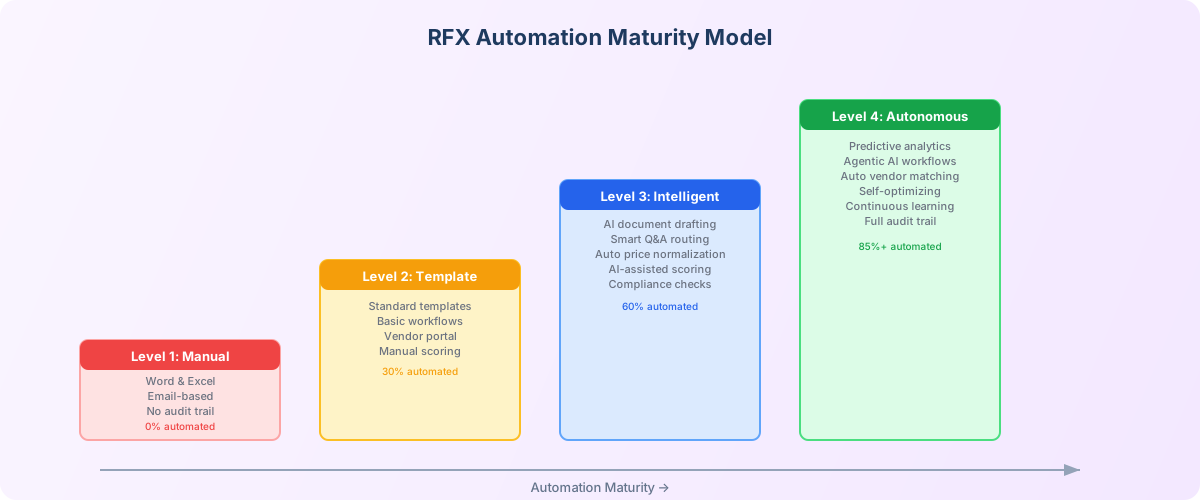
Figure 2: The four levels of RFX automation maturity
Where are most organizations today?
Research shows 60% of procurement teams are still at Level 1 (Manual) or Level 2 (Template). Only 15% have reached Level 3 (Intelligent) with AI capabilities. Early movers gain competitive advantages in speed, cost, and compliance that compound over time.
Implementation Roadmap
Successful RFX automation follows a phased approach. Start with high-impact, low-complexity tasks and progressively add intelligence.
Digitize existing processes. Implement template-based document generation, centralized vendor portal, and basic workflow automation.
Templates
Standardized RFX docs
Portal
Vendor self-service
Workflows
Approval routing
Target
20% faster cycles
Add AI capabilities. Deploy AI-assisted drafting, automated Q&A responses, smart scoring, and price normalization.
AI Drafting
Auto-generate sections
Smart Q&A
AI answer suggestions
Auto Scoring
AI proposal analysis
Target
40% faster cycles
Enable predictive and autonomous features. Implement predictive analytics, autonomous vendor recommendations, and continuous learning from outcomes.
Predictive
Forecast outcomes
Agentic AI
Autonomous workflows
Learning
Continuous improvement
Target
60% faster cycles
Measuring ROI of RFX Automation
40-60%
Cycle Time Reduction
From 6 weeks to 2-3 weeks
50-70%
Less Manual Effort
20+ hours saved per event
15-25%
Cost Savings
Via broader competition
3-6 mo
Payback Period
Typical ROI timeline
Time Savings
Cost Savings
Getting Started with RFX Automation
Map time spent on each RFX stage. Identify bottlenecks, repeated tasks, and compliance gaps. Benchmark your current cycle times and vendor participation rates.
Set targets for cycle time reduction, manual effort savings, vendor participation rates, compliance scores, and cost savings from increased competition.
Standardize your most common RFX types with templates before adding AI intelligence. This creates a strong foundation for automation.
Choose a high-volume procurement category for your first automated RFX. Measure results, iterate, then expand to other categories.
Once proven, roll out to all categories. Enable AI features progressively and use analytics to continuously optimize your sourcing performance.
Common Mistakes to Avoid
- Trying to automate everything at once instead of taking a phased approach
- Ignoring change management - automation only works if people use it
- Choosing a tool before mapping your current process and requirements
- Not measuring baseline metrics before automation (you can't prove ROI without a "before")
Frequently Asked Questions About RFX Automation
Ready to Automate Your RFX Process?
See how Nvelop automates the entire source-to-contract lifecycle with AI-powered tools that cut cycles by 40–60%.